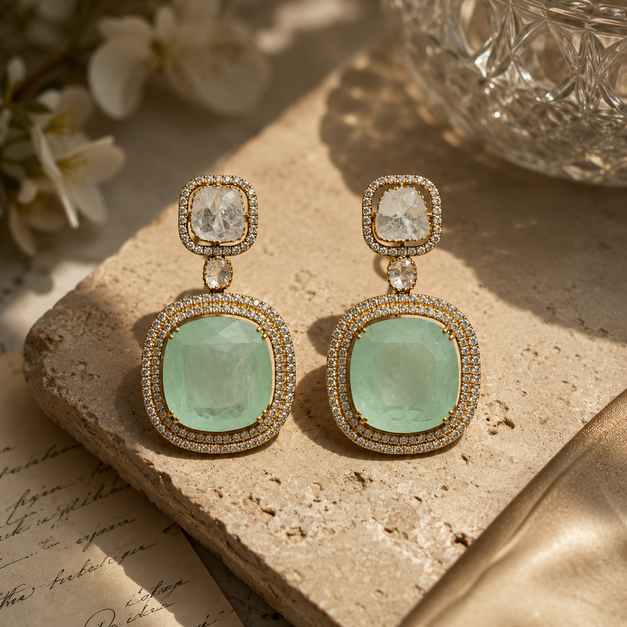
Jadau is one of Rajasthan's most treasured jewelry-making traditions. Originating in the royal courts of Jaipur, this centuries-old craft involves embedding precious gemstones into gold without the use of prongs or adhesives — pure craftsmanship in its most refined form.
Walk through the lanes of Johari Bazaar in Jaipur and you will hear the soft tapping of gold being shaped, the careful placement of gemstones, and the quiet concentration of craftsmen who have inherited a skill from their fathers and grandfathers. This is Jadau — a word that comes from the Hindi root meaning "to embed" — and it is perhaps the most demanding jewelry-making tradition in all of India.
Unlike Western jewelry techniques that use prongs, clasps, or adhesives to hold gemstones in place, Jadau relies entirely on the malleable nature of gold. A skilled karigar (craftsman) heats the gold to a precise temperature, then uses a combination of lac — a natural resin — and extraordinary hand pressure to nestle each stone permanently into its setting. The result is seamless: gemstones appear to float within the gold itself.
A Craft Born in the Royal Courts
Jadau as we know it today traces its origins to the Mughal era, when artisans from Gujarat and Rajasthan were brought to the imperial courts to create jewelry worthy of emperors and their queens. The technique flourished under Mughal patronage and was refined by Rajput royalty who adopted and evolved it into the distinctive Rajasthani style — characterized by vivid gemstones, intricate gold work, and a certain weight and grandeur that commands presence.
Jaipur became the epicenter of this tradition under the reign of Maharaja Jai Singh II in the 18th century. Today the city remains home to the largest concentration of Jadau craftsmen in the world, and it is here at Swastik Jewels that we continue this living heritage.
The Five Stages of Jadau Making
1. Ghaat — Forming the Gold Frame
The process begins with pure gold — typically 23 or 24 karat, chosen for its exceptional malleability. The karigar hammers and shapes the gold into the desired form, whether a choker base, earring frame, or pendant setting. This stage requires both physical precision and artistic vision, as the form created here will determine the entire composition of the piece.
2. Khudai — Engraving the Interior
Once the gold frame is shaped, fine engraving tools are used to create the interior recesses where gemstones will eventually sit. This requires extraordinary precision — the recesses must perfectly match the cut and size of each stone. A single Jadau choker may require hundreds of individually engraved settings.
"In Jadau, there are no second chances. Each stone is set once, and set forever. The gold remembers every touch."— Master Karigar, Johari Bazaar, Jaipur
3. Pakaai — Filling with Lac
Lac — a natural resin secreted by the lac insect — is heated and poured into the interior of the gold frame. This gives the piece its characteristic weight and provides the foundation against which gemstones are pressed and set. The temperature and consistency of the lac is critical: too hot and the gold may distort; too cool and the stones won't embed properly.
4. Jadai — Setting the Stones
This is the namesake stage — the actual embedding of gemstones. With the lac still warm and slightly pliable, the karigar presses each stone into its engraved recess with a specialized tool and steady hand pressure. The gold folds gently around each stone's girdle, holding it permanently. There is no second attempt: once set, the stone cannot be removed without damaging the piece.
5. Meenakari — Enameling the Reverse
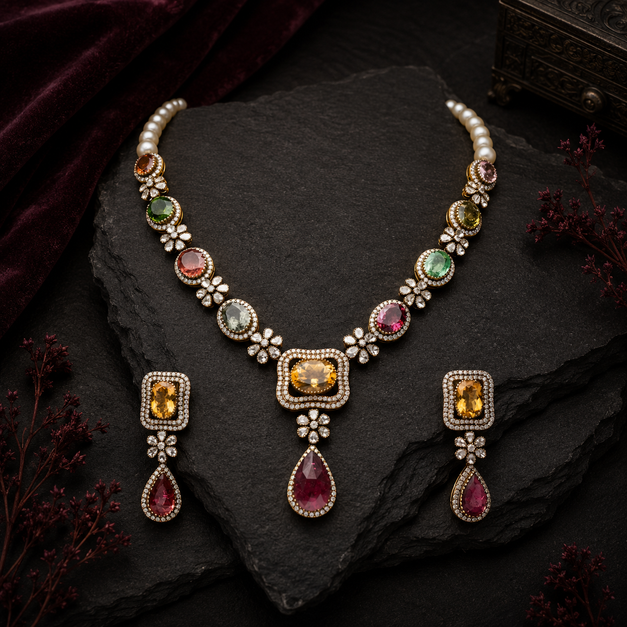
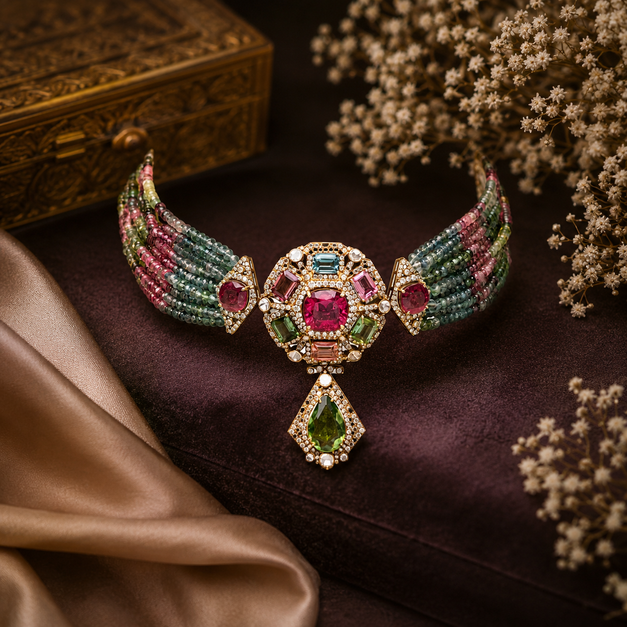
What distinguishes Rajasthani Jadau from all other Jadau traditions is the elaborate enameling on the reverse side of each piece. Called Meenakari, this art involves applying brilliantly colored enamel — deep reds, vivid greens, royal blues — to the back of the jewelry. The reasoning is both aesthetic and philosophical: a Jadau piece should be beautiful from every angle, even when resting against the wearer's skin where no eye will ever see it.
This commitment to hidden beauty is perhaps the most revealing aspect of Jadau as a tradition: it insists on perfection not for the viewer, but for the sake of the craft itself.
The Gemstones of Jadau
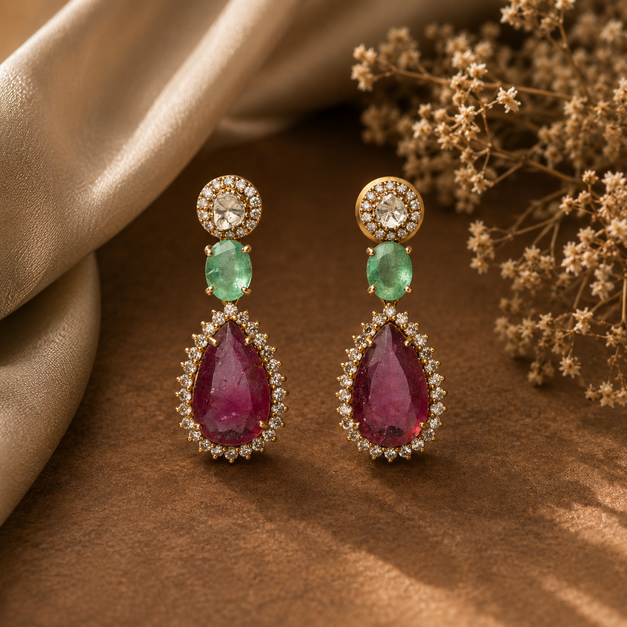
Traditional Jadau jewelry celebrates a specific palette of gemstones, each chosen for its color intensity and cultural significance. Rubies bring the vivid red associated with prosperity and passion. Emeralds, sourced historically from Colombian and Zambian mines via the ancient trade routes, carry the lush green of renewal. Sapphires — deep blue and velvety — speak of wisdom and royalty. Diamonds, in both polished and uncut polki form, provide the sparkle that brings the entire composition to life.
At Swastik Jewels, every gemstone used in our Jadau pieces is individually selected and ethically sourced. We work with gemologists who evaluate each stone not only for its technical quality but for its visual harmony within the final composition.
Jadau Today — A Living Heritage
The greatest challenge facing Jadau today is not demand — brides, collectors, and connoisseurs worldwide recognize the unmatched quality of a true Jadau piece — but the gradual decline in master craftsmen willing to undergo the years of apprenticeship required to learn the trade. A fully skilled Jadau karigar requires a minimum of seven to ten years of training before they can work independently.
At Swastik Jewels, we consider the preservation of this craft a core part of our mission. We support apprenticeship programs, work exclusively with certified Jadau craftsmen, and document our making process so this knowledge is never lost. Every piece we create is not just jewelry — it is a living record of a tradition that has survived for centuries and deserves to flourish for centuries more.
The next time you hold a Jadau piece, look closely at the back. Find the enameled flowers, the hidden birds, the secret garden painted on the surface no one sees. That is where Jadau keeps its soul.